After You’ve Been Cheated On

What to Do (and Not Do)

Discovering that a partner has been unfaithful is one of the most painful experiences a person can go through. In the aftermath, your mind may be racing, and your emotions might feel completely overwhelming. During this turbulent time, it is essential to have a roadmap to help you protect your physical health, your legal rights, and your emotional well-being. Here is a guide on how to navigate the immediate steps following infidelity.

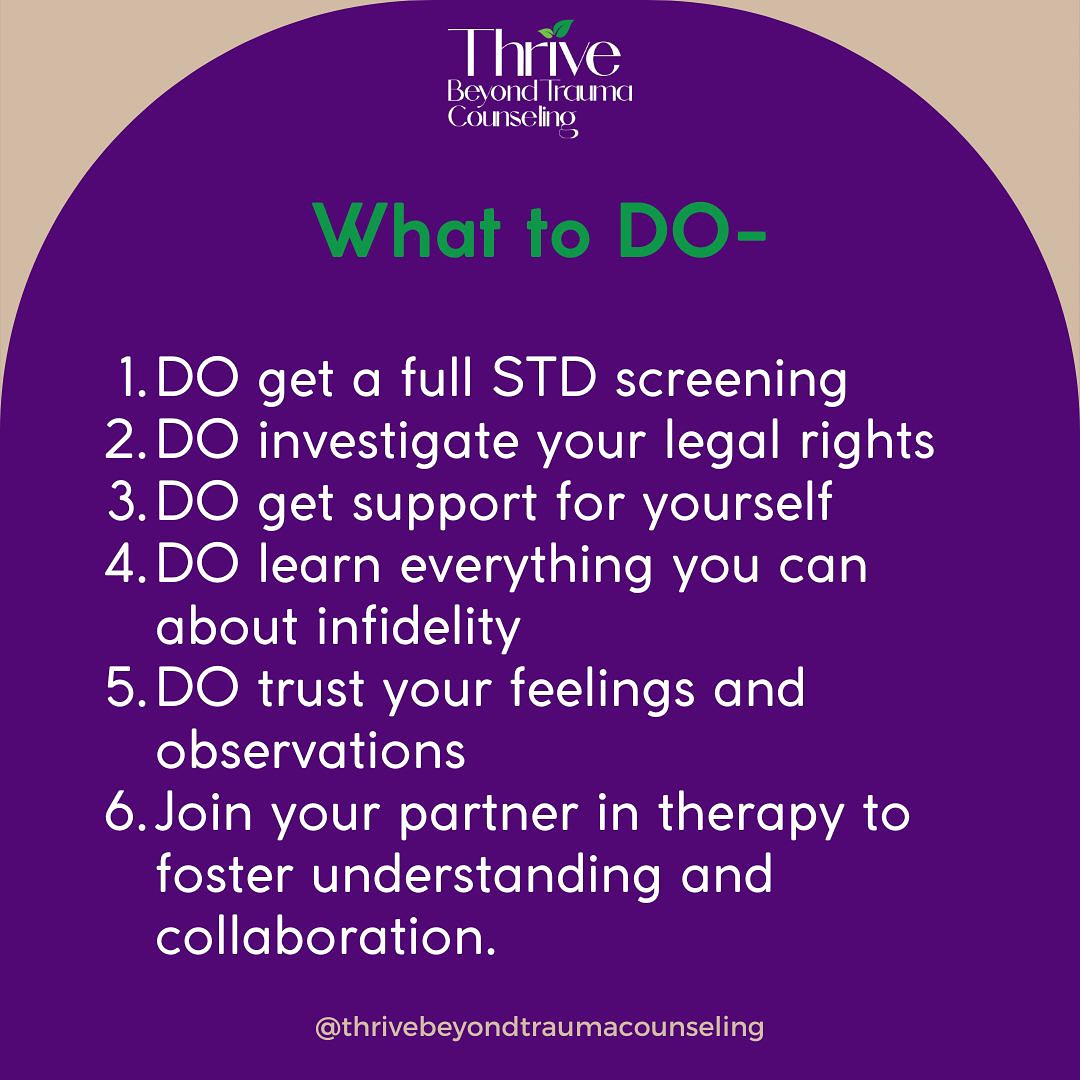
What to DO-

When the initial shock hits, it can be hard to think clearly. Prioritizing these steps will help you regain a sense of agency and safety:

  • DO get a full STD screening: Your physical health is the priority. Regardless of what your partner says, getting tested ensures you have the medical facts.
  • DO investigate your legal rights: Knowledge is power. Understanding your position regarding finances, property, or custody can provide stability during an uncertain time.
  • DO get support for yourself: You don’t have to carry this alone. Reach out to trusted friends, family, or a therapist who can offer a non-judgmental ear.
  • DO learn everything you can about infidelity: Understanding the mechanics of why this happens can sometimes help in de-personalizing the betrayal.
  • DO trust your feelings and observations: Your intuition is a powerful tool. Don’t let anyone gaslight you into doubting what you know or feel to be true.
  • Join your partner in therapy to foster understanding and collaboration. If both parties are willing to do the work, a professional setting is the safest place to explore if the relationship can be repaired.

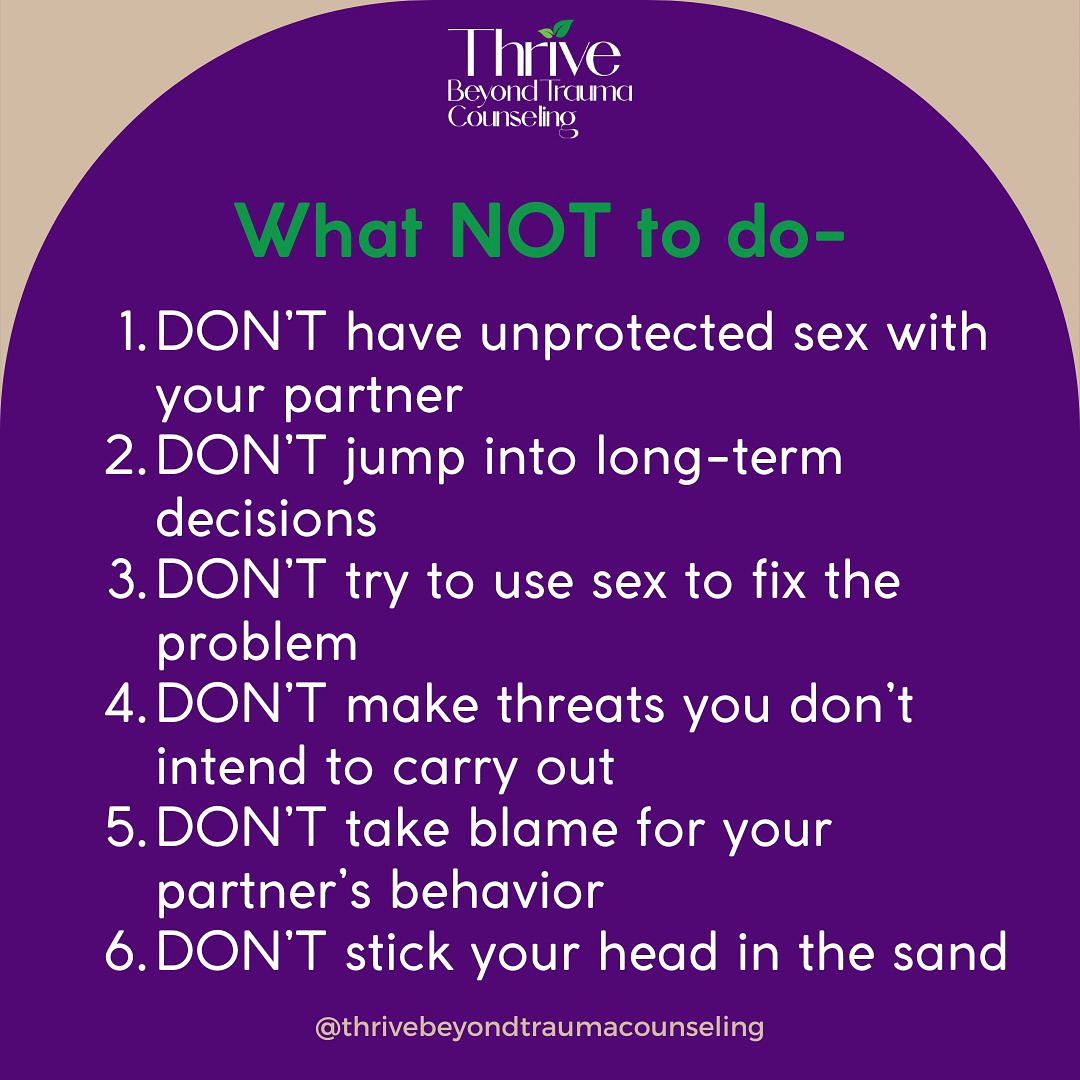
What NOT to do-

While it is tempting to act on impulse when you are hurting, avoiding these behaviors can prevent further trauma and long-term regret:

  • DON’T have unprotected sex with your partner: Until you have full medical clarity and have established a new baseline of trust, protect your physical health.
  • DON’T jump into long-term decisions: Avoid making permanent life changes (like moving or filing for divorce) in the heat of the moment. Give yourself time to process.
  • DON’T try to use sex to fix the problem: “Hysterical bonding” is common, but sex cannot repair the foundational breach of trust that infidelity creates.
  • DON’T make threats you don’t intend to carry out: This can erode your credibility and create a cycle of toxic communication. Only state boundaries you are ready to enforce.
  • DON’T take blame for your partner’s behavior: No matter what issues existed in the relationship, the choice to cheat was your partner’s alone.
  • DON’T stick your head in the sand: Ignoring the problem won’t make it go away. Healing requires facing the truth, however painful it may be.

At Thrive Beyond Trauma Counseling, we specialize in helping individuals and couples navigate the complex trauma of betrayal. Whether you are looking for a path toward reconciliation or need support in finding your strength to move on, our therapists are here to provide a safe, supportive environment for your healing journey. Reach out to us today to schedule a session.

Address: Suite C, 37923 W. 12 Mile Rd, Farmington Hills, MI

Phone: (248) 392-3733

FOLLOW US ON

If you are in crisis or experiencing an emergency, please call 911 or your local emergency services, or visit the nearest emergency room.

Thrive Beyond Trauma Counseling does not provide crisis or emergency services.

Scroll to top