Email: Info@thrivebeyondtraumacounseling.com
Call: (248) 392- 3733

Counselling
Counselling
Addiction
Why We Get Addicted to Feeling Better — The Neurobiology of Emotional Escape
It doesn’t start with destruction.
It starts with relief — that subtle exhale that tells your body, “I can finally breathe.”
A few minutes of scrolling, a drink after work, another episode, another secret click.
The habit looks harmless. But underneath it, the brain and body are running an old survival script: numb to stay alive.
At Thrive Beyond Trauma Counseling, we see this pattern daily — not as weakness, but as wiring.
And the good news is: wiring can be rewritten.
The Brain’s Chemistry of Escape
The human brain evolved for survival, not serenity.
Every emotional or physical threat activates the HPA axis — the body’s central stress system — flooding us with cortisol and adrenaline. These hormones heighten alertness and energy to prepare for defense.
But in trauma, this system never learns to shut off. Even when the danger is gone, the body remains on high alert.
Chronic cortisol keeps the amygdala (the alarm center) hypersensitive and the prefrontal cortex (the logical brain) offline.
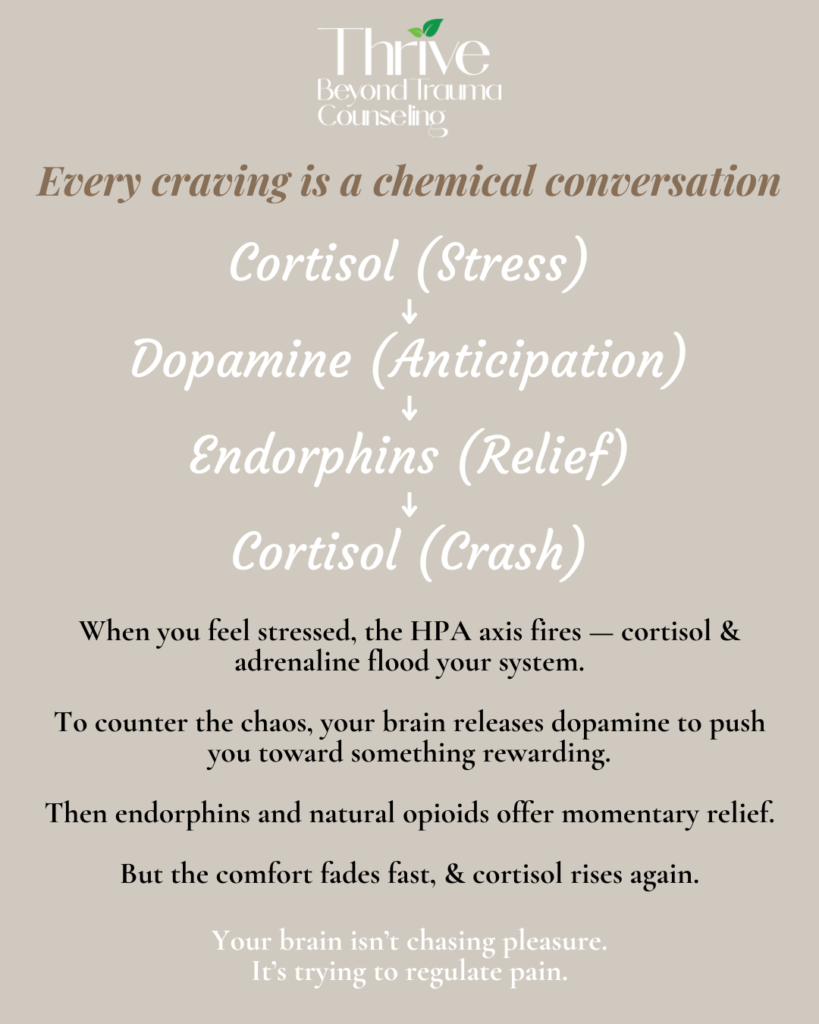
When the brain can’t find safety internally, it looks for chemical shortcuts — anything that mimics calm. That’s where dopamine takes the stage.
Often misunderstood as the “pleasure chemical,” dopamine is actually about anticipation. It motivates pursuit. When you reach for your phone, pour a drink, or initiate a risky behavior, dopamine spikes before the reward. It’s the chemical whisper: “Relief is coming.”
The reward itself — that rush of comfort or numbness — comes from endorphins and endogenous opioids, the brain’s natural painkillers.
But when these pathways are triggered repeatedly, natural regulation weakens. Now, the brain depends on the behavior to feel baseline normal. That’s how emotional escape turns into emotional addiction.
The Trauma Connection: When Survival Hijacks Regulation
In trauma survivors, this loop intensifies. The nervous system can’t distinguish between external threat and internal discomfort — both feel like danger.
Here’s what happens biologically:
- Amygdala stays hyperactive, signaling danger even during calm moments.
- Hippocampus — responsible for time and context — shrinks with chronic cortisol, making emotional memories feel current rather than past.
- Prefrontal cortex — responsible for choice, empathy, and self-control — becomes underactive.
- Nucleus accumbens — the brain’s pleasure and motivation center — becomes overactive in anticipation of relief.
The result: The brain learns to equate relief with safety.
But relief through escape only strengthens the brain’s dependency on external regulation. That’s why people say: “I don’t even enjoy it anymore. I just need it to feel okay.”
They’re not weak. Their nervous systems are trapped in a trauma-conditioned loop — overactivated stress circuits trying to soothe themselves with artificial calm.
The Neurochemical Loop of Addiction
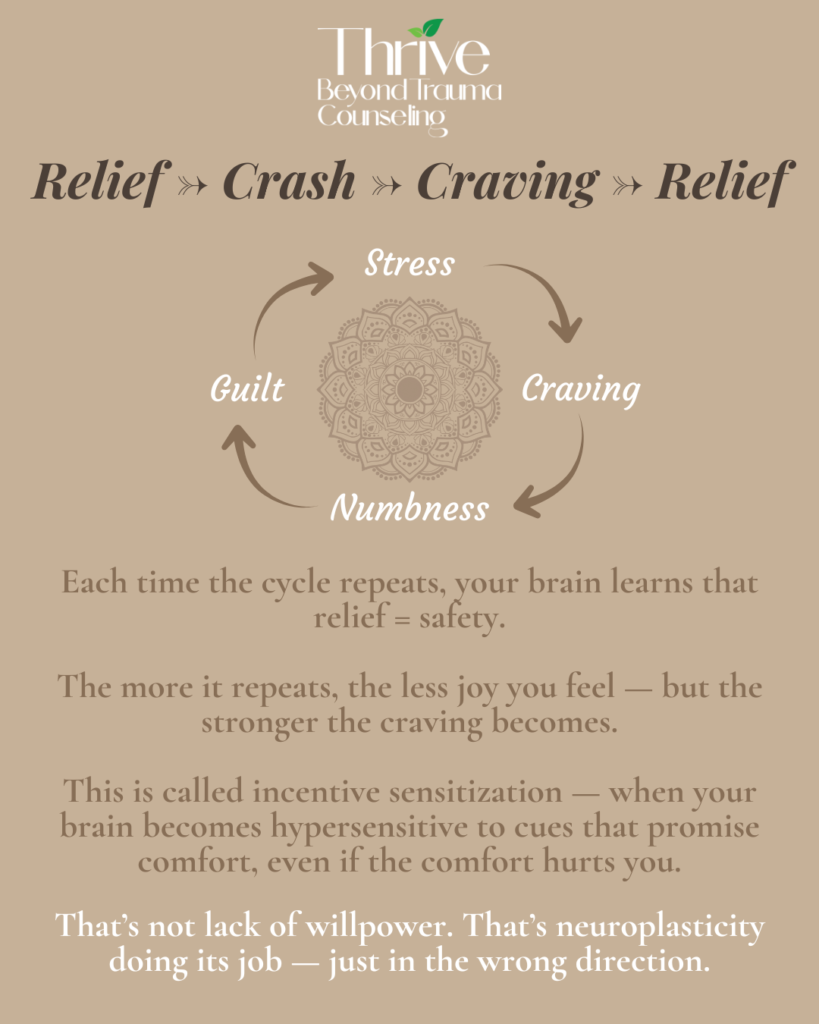
Every compulsive behavior follows the same internal rhythm:
- Stress (Cortisol & Adrenaline) – Triggered by fear, shame, loneliness, or boredom.
- Anticipation (Dopamine) – The body senses possible relief and becomes hyper-focused on the behavior.
- Reward (Endorphins & Opioids) – The action provides temporary calm.
- Crash (Cortisol Rebound) – Once the relief fades, stress hormones surge again.
- Craving (Dopamine Deficit) – The body demands another hit to restore balance.
Each cycle deepens the brain’s belief that escape = safety.
This is called incentive sensitization — the more you repeat the behavior, the more sensitive your brain becomes to cues related to it.
The pleasure fades. The craving intensifies.
Why the Body Chooses Numbness Over Peace
Neuroscience shows that emotional pain activates the same neural pathways as physical pain — particularly in the anterior cingulate cortex. That’s why heartbreak, betrayal, and loneliness physically hurt.
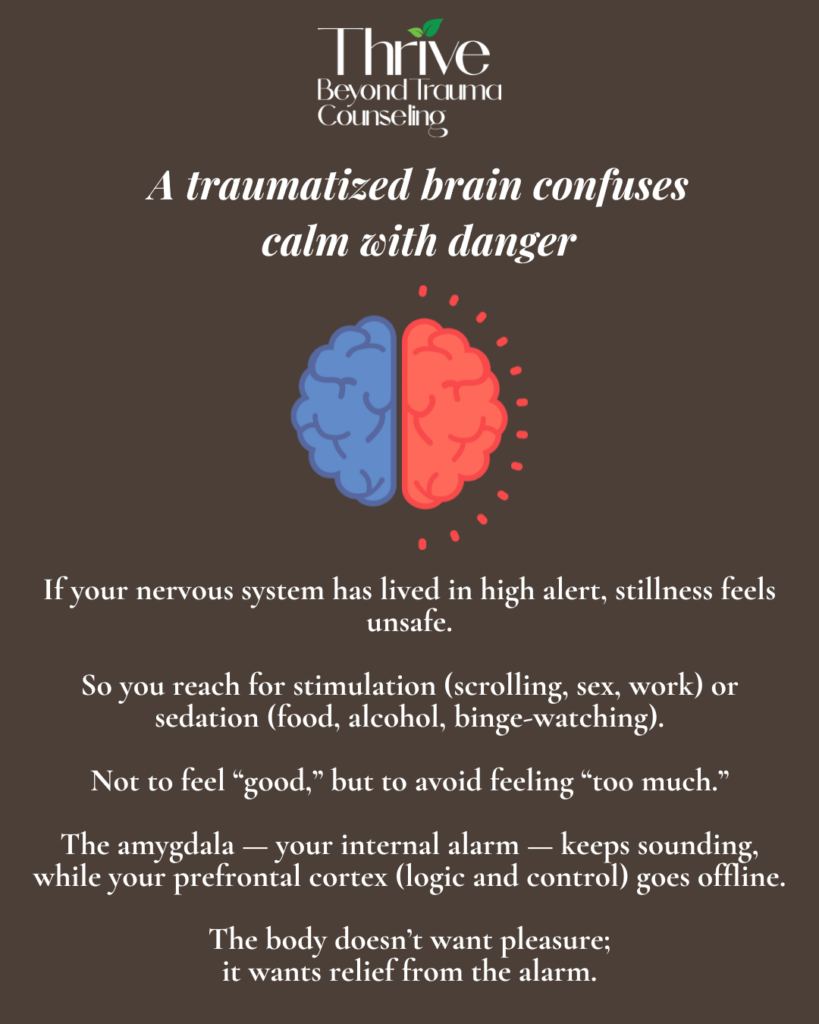
But for trauma survivors, the pain system becomes miscalibrated. Calm feels foreign. Stillness feels unsafe.
The body expects danger even when it’s not there.
So the nervous system seeks stimulation or sedation to regulate.
- Stimulation (scrolling, gambling, porn, high-intensity work) mimics adrenaline and distracts from inner discomfort.
- Sedation (alcohol, food, binge-watching) mimics parasympathetic stillness, offering artificial calm.
Both are biochemical attempts at regulation. Neither provide safety.
Where Science Meets Structure: The CSAT Approach
This is where Thrive’s Certified Sex Addiction Therapist (CSAT) training transforms the healing process.
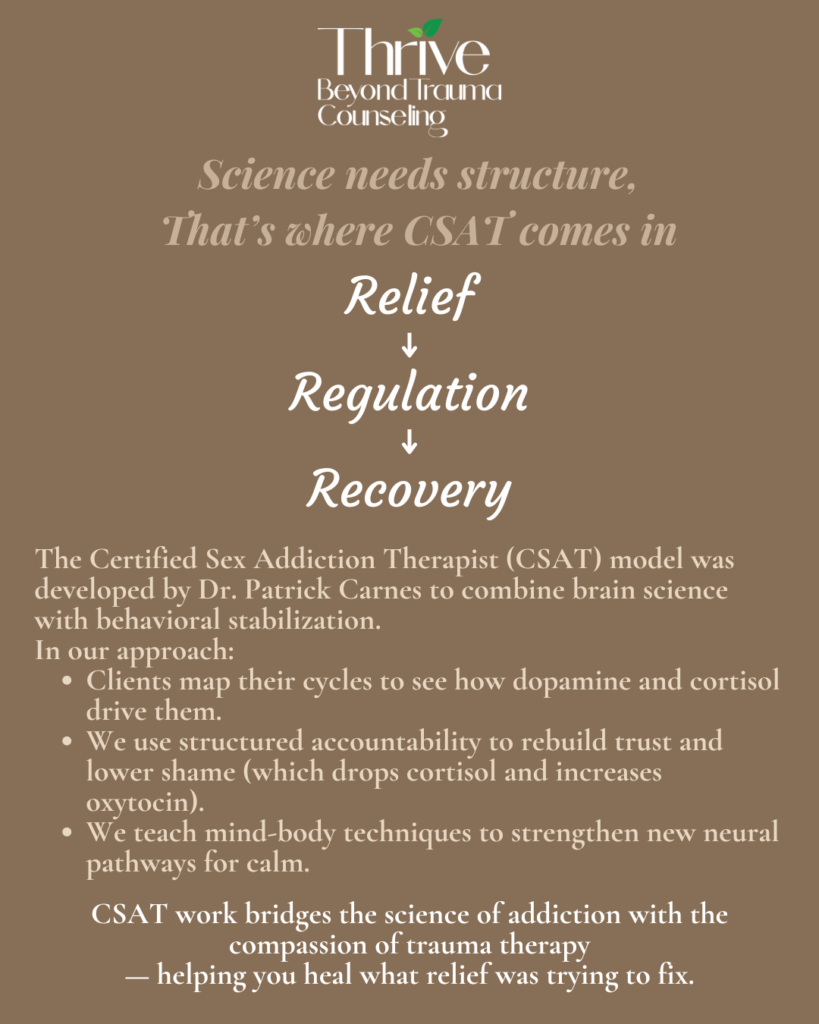
Developed by Dr. Patrick Carnes, the CSAT model is an integrative, trauma-informed program that combines neuroscience, attachment theory, and behavioral assessment to address compulsive and addictive behaviors — especially those rooted in emotional escape and shame.
In CSAT work, we don’t start with control.
We start with stabilization and safety — the foundation of trauma recovery.
Here’s how CSAT integrates into the neurobiological healing process:
1. Assessment and Mapping the Cycle
Clients are guided through identifying triggers, rituals, acting-out behaviors, and consequences. This maps the neurochemical loop in real time — helping clients recognize when cortisol and dopamine are running the show.
Understanding the brain’s rhythm allows clients to intervene before the craving peaks.
2. Trauma Integration and Root-Cause Healing
CSAT-trained therapists recognize that behavioral addiction is rarely about sex, food, or screens — it’s about pain.
Through trauma-informed work, including EMDR and body-based regulation, we help the brain link present behaviors to past stress responses.
The goal isn’t punishment; it’s understanding.
3. Rebuilding the Neurobiology of Trust
Shame and secrecy keep cortisol high. CSAT work creates structured accountability and empathic connection, which increase oxytocin — the neurochemical of bonding and calm.
As clients experience consistent, non-judgmental connection, the nervous system learns that safety can exist in truth.
4. Integration of Mind-Body Modalities
CSAT work at Thrive goes hand-in-hand with hypnotherapy, breathwork, and neuro-regulation tools that teach the body how to return to baseline safely.
This “bottom-up” healing reactivates the vagus nerve, reduces sympathetic overdrive, and rebuilds tolerance for calm.
EMDR, Hypnotherapy, and the Healing Brain
Addiction recovery can’t succeed without trauma repair.
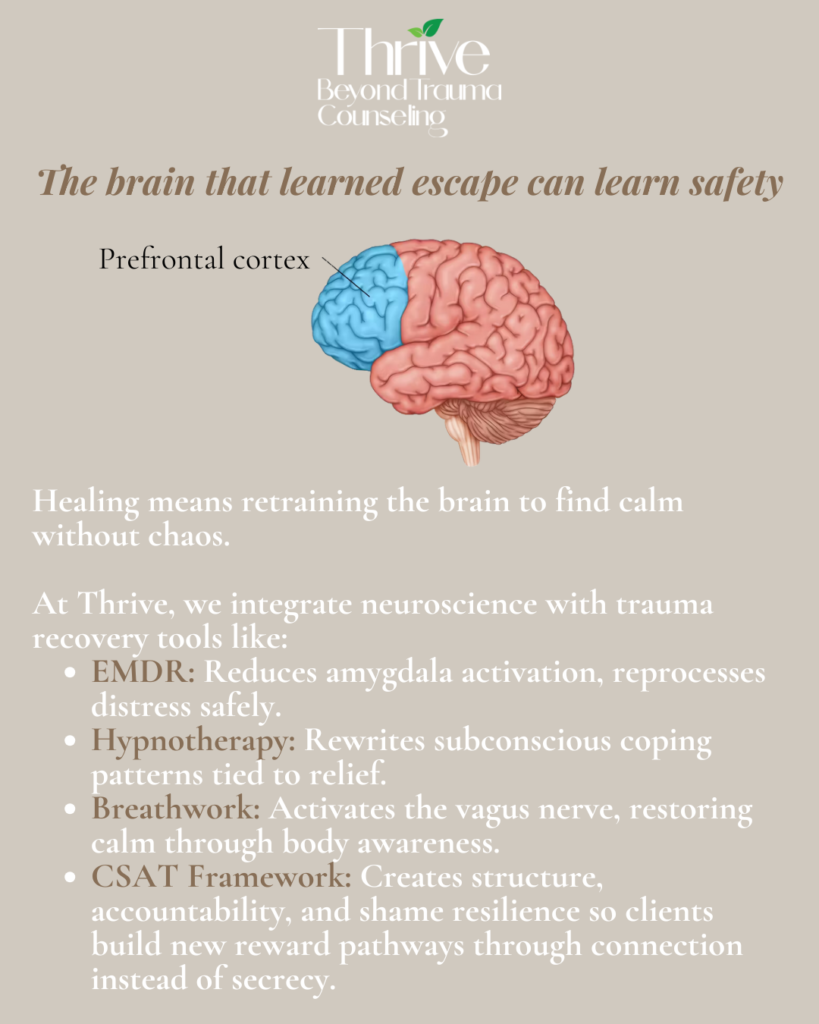
That’s why we combine the CSAT model with EMDR (Eye Movement Desensitization and Reprocessing) and hypnotherapy to treat both the behavior and the nervous system that drives it.
- EMDR helps the brain reprocess stored traumatic memories by activating both hemispheres through bilateral stimulation. This reduces amygdala activity and restores rational control.
- Hypnotherapy accesses subconscious patterns — the autopilot responses formed when the brain first learned that escape equals safety. It replaces those codes with self-trust and calm.
- Breathwork teaches neurophysiological regulation, stimulating GABA and serotonin, and rebalancing the body’s natural opioidergic system.
Together, these interventions rewire the brain’s association from “I need to escape” to “I can handle this.”
What Healing Looks Like in the Brain
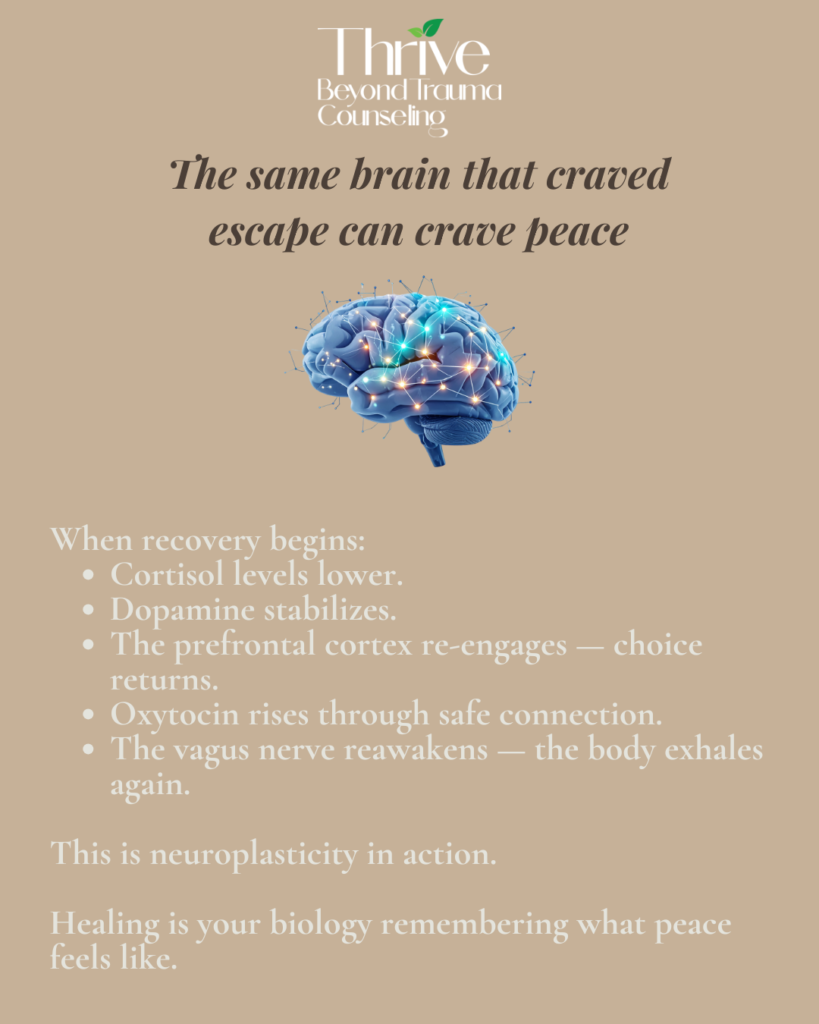
Over time, with integrated CSAT and trauma-informed therapy, the neurobiology begins to change:
- Cortisol levels stabilize, reducing chronic stress.
- Dopamine receptors regain sensitivity, allowing pleasure in small moments again.
- The Prefrontal Cortex re-engages, strengthening self-regulation and choice.
- The Amygdala quiets, allowing the body to rest.
- Oxytocin rises naturally through authentic connection.
The result isn’t abstinence alone — it’s neurobiological recalibration.
The brain learns to generate safety internally rather than outsource it to escape.
Why Shame Cannot Heal What It Created
One of the core truths in the CSAT philosophy — and a foundational value at Thrive — is that shame fuels addiction, but compassion rewires it.
Neuroscience backs this up. Studies show that self-criticism activates the same brain regions associated with pain, while self-compassion activates areas linked with safety and bonding.
That’s why trying to “hate yourself into healing” never works.
We replace moral judgment with neurobiological understanding.
We help clients see their behaviors not as evidence of failure, but as messages from a body asking for regulation.
Because when the brain stops fearing itself, it can finally start healing.
The Return to Regulation & Meaning
Healing is not about never craving again. It’s about developing the capacity to notice the craving — and choose differently.
Clients often describe a subtle but powerful shift:
They pause before reacting.
They feel discomfort without drowning in it.
They reach for connection instead of escape.
On a neurological level, this is integration — the prefrontal cortex regaining influence, the amygdala relaxing, dopamine stabilizing, and oxytocin rising through trust. On a human level, this is peace.
At Thrive Beyond Trauma Counseling, we integrate the science of the brain with the structure of the CSAT program and the compassion of mind-body therapies to create comprehensive healing for behavioral addiction and emotional dysregulation.
Our approach isn’t about control — it’s about reconnection.
We help the brain remember what safety feels like so the body no longer needs to escape to find it.
Because healing isn’t about suppressing your need to feel better.
It’s about teaching your nervous system that feeling is safe.
📍 Suite C, 37923 W. 12 Mile Rd, Farmington Hills, MI
📞 (248) 392-3733