
Thrive Beyond Trauma Counseling
Healing Doesn't End at Survival; It Begins With Thriving. Helping Individuals, Couples, & Families Heal, Grow & Thrive Beyond Trauma.
Thrive Beyond Trauma Counseling
Thrive Beyond Trauma Counseling
Healing Doesn't End at Survival; It Begins With Thriving. Helping Individuals, Couples, & Families Heal, Grow & Thrive Beyond Trauma.
Your Brain's Response to Trauma
Ever feel like you’ve been highjacked? When your brain is triggered by stress or trauma, your normal way of thinking can be instantly turned off, and replaced with a purely protective response. You are no longer navigating, you are just reacting and trying to survive. This isn’t a sign of weakness; it’s a profound demonstration of your brain’s protective, albeit sometimes overwhelming, power. Let’s explore what’s happening when your brain takes over in a moment of distress.
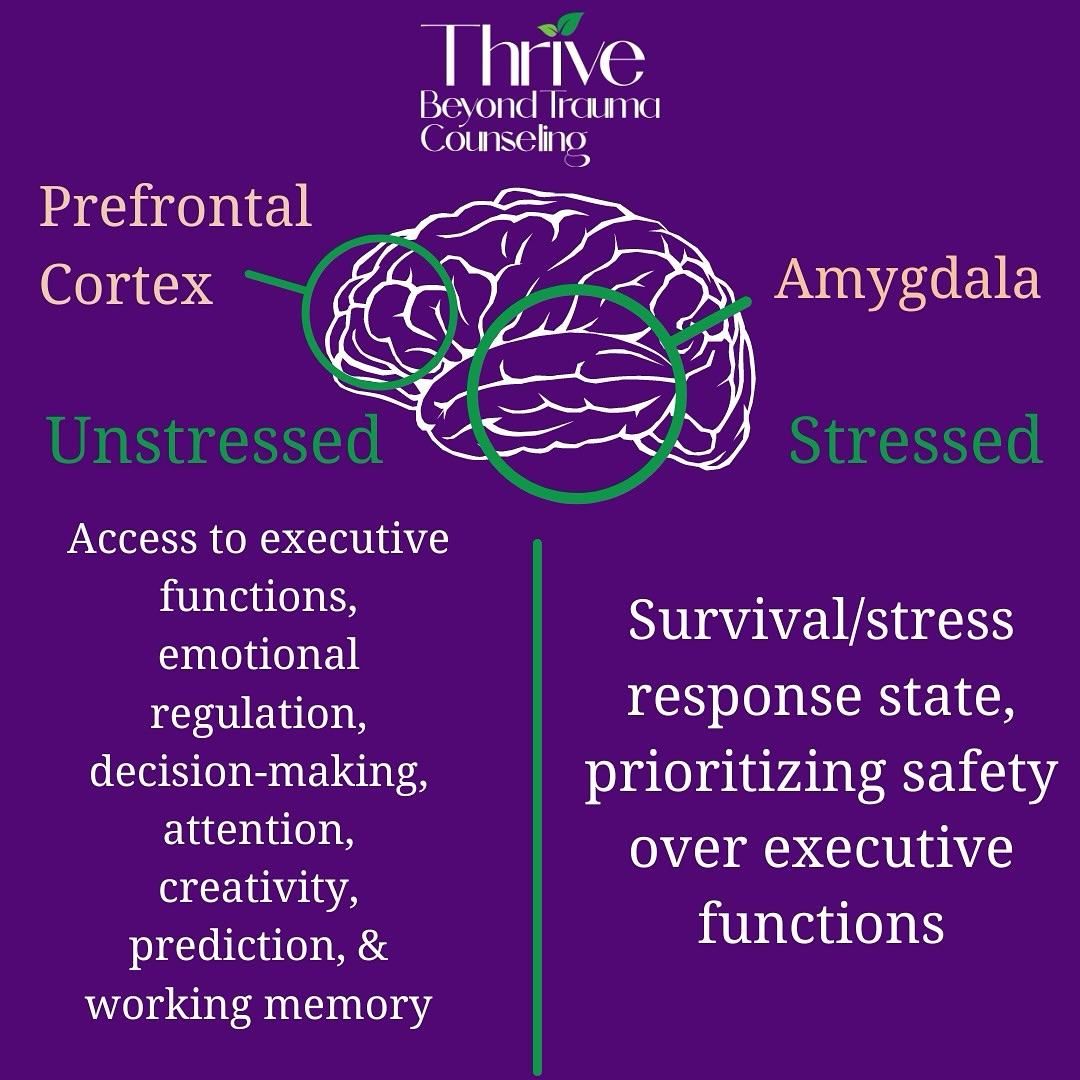
Prefrontal Cortex vs. Amygdala
Your brain has two main decision-makers that can take the reins: the Prefrontal Cortex and the Amygdala. They have very different ways of responding to the world around you. Your Prefrontal Cortex, located at the front of your brain, is the center for executive functioning. Think of it as the wise manager that helps you evaluate situations and make rational choices. It handles emotional regulation, decision-making, attention, and creativity. In contrast, the Amygdala, nestled deep in your brain, is like an alarm system. Its sole focus is identifying threats and triggering the fight-or-flight response. When the Amygdala is activated, its primal instinct is to protect you, regardless of how “irrational” its actions might seem to your conscious mind. It doesn’t have time for nuance, it just wants you to be safe. Understanding this dynamic is the first step toward reclaiming control and healing from trauma.
Unstressed Brain
In an unstressed brain, your Prefrontal Cortex is in the driver’s seat. Here, your nervous system is calm, allowing you to access higher-level cognitive functions. You can process information calmly, make deliberate and thoughtful choices, and regulate your emotions effectively. This is the state where connection, growth, and problem-solving are possible. A sense of safety allows this part of your brain to perform at its best. This state is often called “Rest and Digest,” which is a wonderful place to be.
Stressed Brain
In a stressed brain, the story is completely different. When your brain senses a threat: whether it’s real or a reminder of past trauma; the Amygdala takes control. It initiates a rapid-fire survival/stress response state, prioritizing safety over all other functions. Your Prefrontal Cortex is essentially “offline.” The focus shifts to immediate, automatic reactions. While this response can be lifesaving in actual danger, the aftermath of trauma can leave this alarm system easily activated by non-life-threatening triggers. This is often called the “Fight or Flight” response.
How Counseling Helps
The brain, in its incredible resilience, has a natural ability to reorganize itself and form new neural pathways. Counseling is a powerful way to leverage this neuroplasticity to navigate and ultimately resolve trauma. In therapy, we work to decrease amygdala activation and reinforce connections to the Prefrontal Cortex. We offer tools and strategies, like EMDR, to process and integrate traumatic memories, allowing your brain to differentiate between a past event and the present moment. We help you build skills for emotional regulation, enabling you to bring yourself back to a state of calm and restore access to your executive functions. The journey from a “stressed” to an “unstressed” brain is a path from reactive survival to authentic, conscious living. You can move beyond just coping and start truly thriving.
At Thrive Beyond Trauma Counseling, we understand the complexities of trauma and are here to guide you. If you’re ready to reclaim control and begin your healing journey, reach out to schedule an appointment today. Let’s help you move beyond survival mode and into a life of peace and connection.
Address: Suite C, 37923 W. 12 Mile Rd, Farmington Hills, MI
Phone: (248) 392-3733
FOLLOW US ON
If you are in crisis or experiencing an emergency, please call 911 or your local emergency services, or visit the nearest emergency room.
Thrive Beyond Trauma Counseling does not provide crisis or emergency services.